
Solar and Inverter Sizing for Nigerian School Computer Labs: A Practical Blueprint
The Diesel Trap in Nigerian School IT Labs
For private school proprietors across Nigeria, operating a 40-seat or 60-seat computer laboratory has become a punitive financial drain. With petrol prices exceeding ₦900 per litre and automotive gas oil (diesel) fluctuating above ₦1,200 per litre, fueling a 15kVA to 25kVA generator for daily computer studies and termly CBT mock examinations can easily consume ₦450,000 to ₦700,000 every single month.
Even worse, generator power introduces severe voltage spikes, harmonic distortion, and dirty power frequencies that degrade monitor power supplies, fry motherboard capacitors, and cause random system freezes mid-exam. Transitioning to dedicated solar inverter systems is no longer an environmental luxury—it is an urgent operational necessity.
1. The Foundation: Energy Auditing and Thin-Client Efficiency
The catastrophic mistake school owners make when requesting solar quotations is sizing the system for legacy desktop computers. A standard secondhand Core i5 desktop PC with a CRT or early LCD screen pulls 250 to 350 Watts. Multiplying that by 50 workstations yields an astronomical 15 kW to 17.5 kW load, requiring a massive ₦25M+ solar installation that few schools can afford.
The secret to affordable school lab solar is Ultra-Low-Power Mini-PCs:
- Modern Intel Celeron / N-series Mini-PCs: Consume only 12 to 18 Watts under full computational load.
- Energy-Star LED Monitors: 19-inch to 21.5-inch LED panels draw only 15 to 18 Watts.
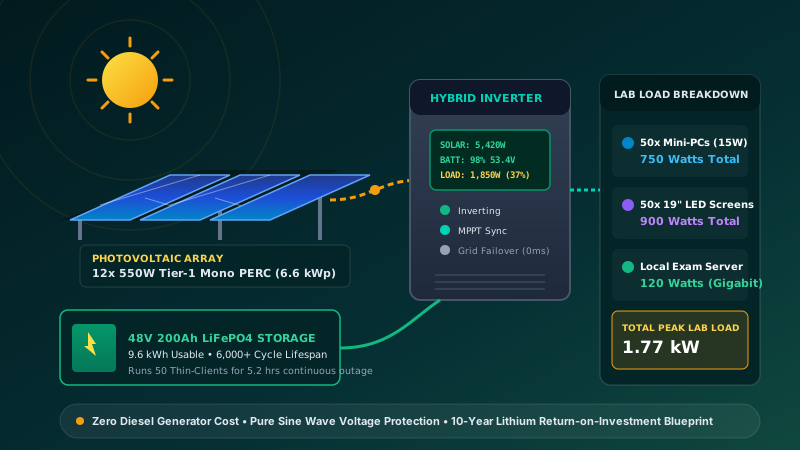
- Combined Workstation Load: Just 32 Watts per seat. A 50-student lab draws only 1,600W (1.6 kW) total—ten times less than traditional desktops!
- Local Server & Gigabit Switch: ~150 Watts combined.
- Total Lab Power Demand: Approximately 1.8 kW.
2. Sizing the Hybrid Inverter: Pure Sine Wave is Non-Negotiable
Modified sine wave inverters are completely unsuitable for computer labs; their square-wave AC outputs overheat switch-mode power supplies and inject audible hum into network audio equipment. Always specify a Pure Sine Wave Hybrid Inverter.
- Inverter Capacity: For a 1.8 kW continuous lab load, choose a 5kVA to 7.5kVA (48V) Hybrid Inverter. This operates the lab at a comfortable 40% to 50% capacity, leaving ample overhead for monitor inrush currents and future seat expansion.
- Integrated MPPT Solar Charge Controller: Dual MPPT inputs (100A to 120A, 500V VOC) ensure maximum solar energy harvesting even during overcast rainy season mornings in southern Nigeria.
- Zero-Transfer Time (0ms): Ensure the inverter supports online UPS transfer (or <10ms standard transfer) so workstations never reboot when switching between solar, battery, and national grid.
3. Battery Chemistry: Why Tubular Lead-Acid is False Economy
While tubular flooded or gel lead-acid batteries have a lower initial sticker price, they fail rapidly in school laboratory environments:
- Lead-acid batteries deliver only 50% usable Depth of Discharge (DoD) and degrade within 18 to 24 months under daily cycling.
- The Winner: Lithium Iron Phosphate (LiFePO4): Delivers 90% usable DoD, zero toxic fumes, and lasts 6,000+ deep cycles (10 to 12 years of daily school use).
- Recommended Battery Bank: A 48V 200Ah Lithium Battery Pack (9.6 kWh usable energy). This powers a 1.8 kW 50-seat computer lab for 5.3 hours of continuous runtime during total grid and solar outage—more than enough for two consecutive exam sessions.
4. Rooftop Solar Panel Configuration
In Nigeria's tropical solar climate, average peak sun hours range from 4.5 hours/day in the South to 6.2 hours/day in the North:
- Array Size: 12x 550W Monocrystalline Tier-1 Solar Panels (6.6 kWp total array).
- Daily Generation: Produces 24 to 32 kWh per day, completely powering the lab during school hours (8:00 AM to 3:00 PM) while fully recharging the lithium battery bank simultaneously.
Return on Investment: The 14-Month Payback
A properly engineered 50-seat Mini-PC solar lab costs approximately ₦6.8M to ₦8.5M complete with panels, lithium battery, and 5kVA inverter. At current fuel savings of ₦550,000 monthly, the system achieves 100% net payback within 13 to 15 months, after which the school operates its computer lab and CBT exams with zero fuel expenditure for the next 10 years.
Contact Harmony Digital Consults for a complimentary electrical load audit and custom solar sizing blueprint for your school's ICT facilities.
Share this article
Interested in learning more? Get in touch with us.