
School Fee Collection in Nigeria: Modernizing Termly Payments Without Alienating Parents
The Termly Financial Crisis in Nigerian Schools
For most private school proprietors across Nigeria, the first four weeks of any term are consumed by administrative anxiety. Hundreds of parents submit crumpled paper bank tellers, unverified mobile transfer screenshots with obscured transaction reference IDs, or cash envelopes that require manual counting and bank deposit trips subject to armed robbery risks.
Meanwhile, accounts clerks spend weeks cross-referencing bank statements against student ledgers, only to discover ghost payments or find that two parents with the same common surname have been credited for each other's wards. There is a far more dignified, leak-proof way to collect termly school fees.
1. The Flaws of the 'Single School Bank Account'
When a school gives all 450 parents the same corporate bank account number, reconciliation becomes a mathematical nightmare:
- Parents frequently transfer from a third-party account (a spouse, business partner, or roadside POS agent) whose sender name bears zero resemblance to the student's name.
- Fake bank alert scams: Fraudulent transfer receipts generated via SMS generator apps deceive gate staff and result in students receiving clearance before funds clear.
- Manual accounting delays prevent the school from knowing its exact cash position until mid-term, delaying staff salaries and utility payments.
2. The Fix: Dedicated Student Virtual Accounts (DVA)
Modern educational technology eliminates manual reconciliation through Dedicated Virtual Accounts. In this system:
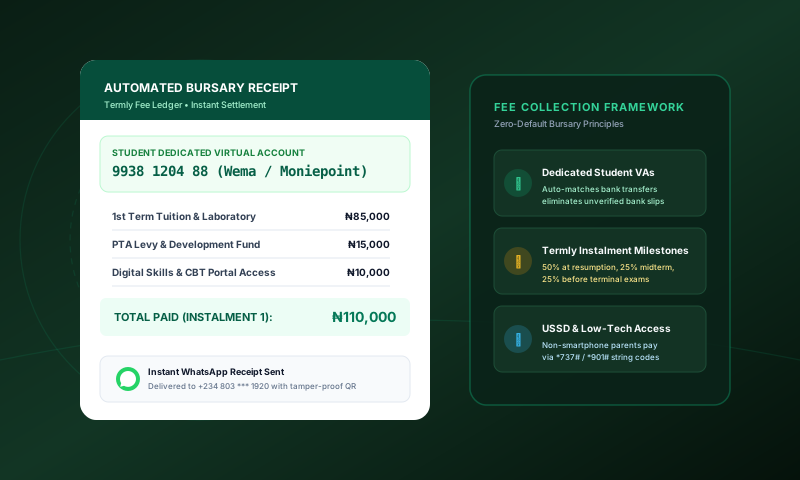
- Every enrolled pupil is assigned a permanent, unique 10-digit NUBAN account number (e.g., Wema Bank, Providus, or Moniepoint) generated under the school's master merchant account.
- When a parent transfers to their child's dedicated account via any mobile banking app, USSD string, or POS kiosk, the school management system receives an instant webhook confirmation.
- The payment is credited directly to the student's specific bursary ledger within 3 seconds, without requiring any human verification or paper slip submission.
3. Instant WhatsApp Receipts & Parent Trust
In Nigeria, email notifications are often ignored, but WhatsApp messages are opened within minutes. The moment a fee payment settles:
- The bursary system automatically dispatches an official digital receipt via WhatsApp to the verified guardian's phone number.
- The receipt includes the school's RC number, student name, admission number, term, exact breakdown of fees paid, outstanding balance, and a tamper-proof verification QR code.
- Parents gain immediate peace of mind, and the school eliminates physical print costs for paper receipt booklets.
4. Designing Flexible Termly Instalment Schedules
Inflation and economic realities in Nigeria make upfront 100% payment difficult for many honest families. Rather than issuing abrasive public shaming notices that humiliate children, high-retention schools adopt structured milestone agreements:
- Resumption Milestone (50%): Covers books, uniforms, and initial term operational costs.
- Mid-Term Milestone (25%): Paid before mid-term assessments.
- Terminal Milestone (25%): Settled 10 days before final terminal examinations.
HavonTrack Nigeria integrates automated virtual accounts, SMS payment links, and automated WhatsApp bursary receipts out of the box. Speak with our financial systems specialists to automate fee collection for the upcoming academic term.
Share this article
Interested in learning more? Get in touch with us.