
Cybersecurity Hygiene for Nigerian School Administrators: Securing Question Banks & Biodata
The Quiet Threat to School Reputation in Nigeria
When Nigerian school proprietors think about security, they invest in perimeter fencing, uniformed security personnel, and iron gates. Yet, the most devastating threats to modern institutional reputation are entirely digital: an leaked terminal examination question paper circulating on student WhatsApp groups 12 hours before the exam, or an account database containing 800 children's home addresses and biometric fingerprints ransomed by malicious cyber actors.
With the Nigeria Data Protection Commission (NDPC) actively investigating institutional data controllers and levying statutory penalties, school boards can no longer treat cybersecurity as an afterthought.
1. Anatomy of an Exam Paper Leak
Contrary to popular belief, exam papers are almost never stolen by elite external hackers breaking into school servers. 90% of school leaks occur through mundane administrative lapses:
- Unencrypted USB Flash Drives: Subject teachers type question papers at commercial business centers or transfer files between home laptops using cheap unencrypted USB thumb drives that are easily misplaced or duplicated.
- Shared Administrative Accounts: The school's master computer in the Vice Principal's office uses a single, shared Windows login password known to accounts clerks, exam committee members, and student prefects running errands.
- Unmonitored Commercial Printing: Exam papers sent to third-party commercial printing presses in roadside markets, where press operators produce unauthorized copies for fee-paying candidates.
2. The Zero-Leak Protocol for Examination Committees
To eliminate examination leakage permanently:
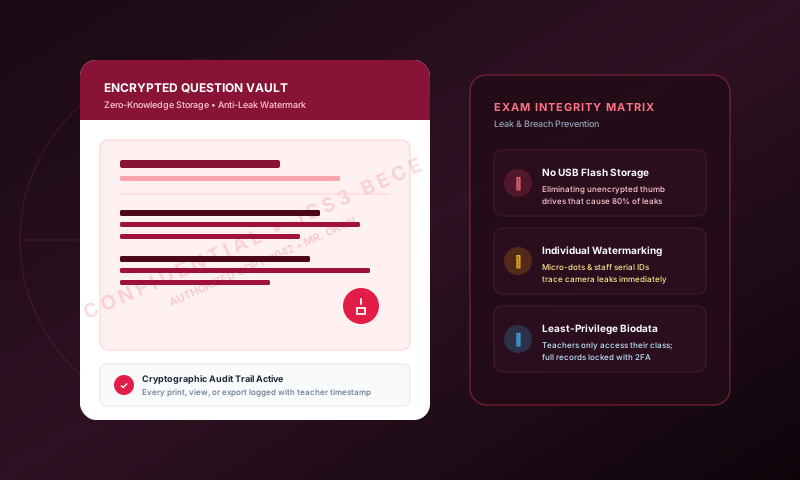
- Centralized In-House Question Bank: Teachers submit questions into an encrypted cloud or local server question repository. The full examination paper is compiled algorithmically by the Examination Committee only 24 hours prior to the test.
- Role-Based Access Control (RBAC): Class teachers have access only to their own specific subject questions. They cannot view or export questions submitted by colleagues in other departments.
- Forensic Watermarking: Every printed or rendered examination sheet carries a unique, serialized faint background watermark indicating the copy number and the authorized supervisor's identity. If a paper is photographed and shared on WhatsApp, the originating source is traced in 30 seconds.
3. Safeguarding Student Biodata Under the NDPA 2023
Under the Nigeria Data Protection Act 2023, school administrators carry direct legal liability for child data breaches. Implement these non-negotiable safeguards:
- Strict 2-Factor Authentication (2FA): Require SMS or authenticator app 2FA on every administrator account accessing student records, broadsheets, and parent financial ledgers.
- Secure Internal Communications: Cease posting student medical records, disciplinary reprimands, and fee debt lists in public staff WhatsApp groups. Use encrypted, access-controlled school portals.
- 72-Hour Incident Response Readiness: Maintain an incident response protocol so any data compromise can be investigated, contained, and reported to the NDPC within the statutory 72-hour window.
Audit Your School's Digital Defenses
Harmony Digital Consults provides institutional security assessments based on the NIST CSF and NDPA compliance frameworks. Use our Free NDPA School Audit Tool to evaluate your institution's compliance score, or explore HavonaShield, our dedicated EdTech cybersecurity and data protection suite.
Share this article
Interested in learning more? Get in touch with us.