
Offline-First School Management Software: Why Nigerian Schools Need It
The Day the Internet Failed Roll Call
It is 8:15 on a Monday morning in a secondary school in Onitsha. The class teacher opens the school's cloud-based management dashboard to mark attendance for 42 students. The login screen spins. The router blinks red. Somewhere in the staff room, a generator coughs to life. By the time the system loads, registration is over, three lessons have started late, and the teacher has resorted to a paper register she will have to manually transcribe later. By Friday, that paper register is missing.
This is not a hypothetical. This is the lived reality of digital education in Nigeria, and it is the reason offline-first school management software is not a feature. It is a requirement.
What Offline-First Means, Precisely
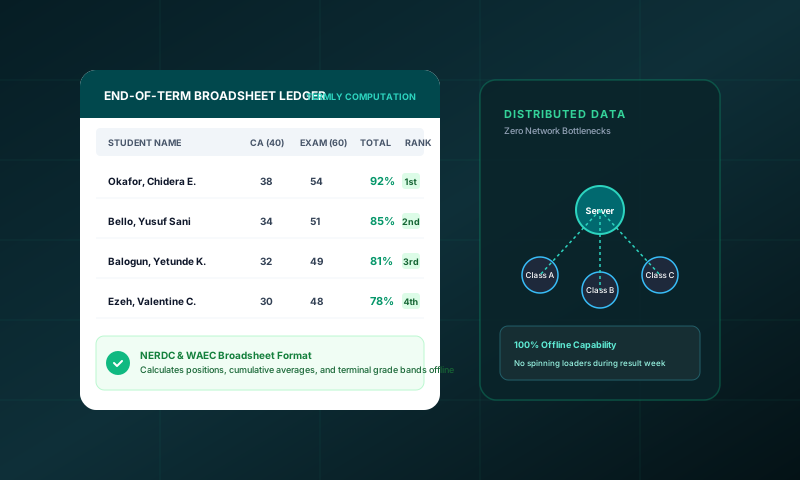
An offline-first application is one that treats network connectivity as an optional enhancement, not a precondition for operation. Every core function works on the device, against local data. When connectivity is available, the application syncs in the background. When it is not, the user does not notice.
This is enabled technically by three components working together: Progressive Web App (PWA) shell architecture, a service worker that intercepts network requests and serves cached responses, and a local database (typically IndexedDB) that stores records on the device until they can be pushed to the cloud.
The key distinction: an offline-capable app might let you view cached data when offline. An offline-first app lets you read, write, edit, and delete data offline, then reconciles it intelligently when connection returns.
Why This Matters More in Nigeria Than Anywhere Else
Internet penetration in Nigeria reached approximately 55 percent in early 2026, but the headline number conceals a brutal distribution. In Lagos, Abuja, and Port Harcourt, broadband is widely available though unevenly priced. In rural Anambra, Benue, or Sokoto, schools often rely on a single mobile router shared by hundreds of users, sitting behind power that fails several times a day.
The Nigerian Communications Commission has reported that data costs as a percentage of average monthly income remain among the highest in the world. Even when connectivity exists, schools ration it. Teachers wait for off-peak windows. Administrators batch their work. The result is that cloud-only software in this environment behaves less like a productivity tool and more like a permission slip the school has to renew every fifteen minutes.
What Breaks Without Offline-First
- Attendance becomes unreliable. Teachers who cannot mark registers in real time fall back on paper. Paper gets lost. Attendance data, the foundation of safeguarding and government reporting, becomes incomplete.
- Continuous assessment data is delayed. If a teacher cannot enter test scores until the network is up, scores get entered in bulk at the end of term, often inaccurately, and parents cannot track progress.
- Parent communications fail at the worst moments. A school cannot push an urgent broadcast about a closure or emergency if its messaging tool depends on the same internet the school does not have.
- Government reporting suffers. Universal Basic Education Commission (UBEC) and state SUBEB reports have hard deadlines. A system that cannot pull together attendance and enrolment data because the cloud is unreachable puts the school out of compliance.
What to Look for in an Offline-First SMS
Not every vendor that puts "offline" on its marketing page is actually offline-first. Use this checklist when evaluating options:
- Full write capability offline. Can a teacher mark attendance, enter grades, record fee payments, and write incident reports while the device is in airplane mode? Test this. Switch the Wi-Fi off and try.
- Conflict resolution. When two devices edit the same record offline, what happens at sync time? A serious offline-first product has a documented conflict-resolution strategy. Ask the vendor to explain it.
- PWA installation, not native app dependency. A PWA installs from the browser, updates silently, and runs on any modern phone or laptop. A native app that needs to be downloaded from a Play Store the school cannot access on its restricted Wi-Fi is a hidden barrier.
- Local-first data storage. Data should live on the device, encrypted at rest, with sync as a secondary operation. Ask where data is stored before it reaches the cloud.
- Battery and bandwidth efficiency. An offline-first app should be smaller, faster, and lighter on data than its cloud-only equivalent. If the vendor cannot tell you the data footprint of a typical day's usage in megabytes, they have not measured it.
- Sync transparency. The user should always be able to see what is pending sync, what has synced, and what failed. Hidden background sync is a recipe for lost data.
The Compliance Angle Most Vendors Miss
Under the Nigeria Data Protection Act (NDPA) 2023, schools are data controllers responsible for the personal data of students, parents, and staff. The act requires appropriate technical and organisational measures to protect this data. A cloud-only system that fails when connectivity drops is not just inconvenient. It is a security risk, because staff routinely default to insecure workarounds such as personal WhatsApp groups, unencrypted spreadsheets, and paper records that are easily lost or photographed.
An offline-first architecture, properly implemented, keeps sensitive data on a managed school device with full encryption and audit logging, even when there is no internet to sync with. This is materially safer than the cloud-only alternative in a low-connectivity environment.
How Harmony Digital Builds Offline-First
Every school-facing product in our suite, including EduTrack Nigeria, Harmony TimeGrid, EduPlanner, and the Exam Prep Suite, is built as a Progressive Web App with a service worker, IndexedDB local storage, and background sync. A teacher in Anaocha, Anambra State, can mark attendance for an entire morning's lessons without a single network request. When the school's router comes back online, every record uploads in seconds.
We did not bolt offline support on as a feature. We started with the assumption that the network would fail, and worked backwards. That changes how the code is written, how data is structured, and how the user experience is designed.
The Bottom Line
If your school is evaluating management software in 2026 and the vendor's first instinct is to ask whether you have stable broadband, walk away. The right question is: "What do we do when the internet is down for three hours?" The right answer is: "Nothing changes."
Offline-first is not a premium feature. In Nigeria, it is the floor. Anything less is asking your teachers, your administrators, and ultimately your students to absorb the cost of an infrastructure problem that was never theirs to solve.
If you would like to see what offline-first looks like in practice, book a free 30-minute demo of EduTrack Nigeria. We will run it in airplane mode in front of you.
Share this article
Interested in learning more? Get in touch with us.