
Demystifying the NERDC Digital Literacy Curriculum: A Practical Guide for School Heads
The Paradigm Shift in Nigerian Basic Education
For over two decades, Computer Studies in the majority of Nigerian primary and junior secondary schools consisted of memorizing parts of a desktop computer: "The CPU is the brain of the computer; the monitor is an output device." Students answered exam questions on floppy disks and CD-ROMs without ever writing a line of code or understanding how digital data influences their daily lives.
The updated basic education guidelines from the Nigerian Educational Research and Development Council (NERDC) fundamentally dismantle this rote approach. The curriculum now mandates computational thinking, basic algorithm design, digital safety, and responsible introduction to Artificial Intelligence.
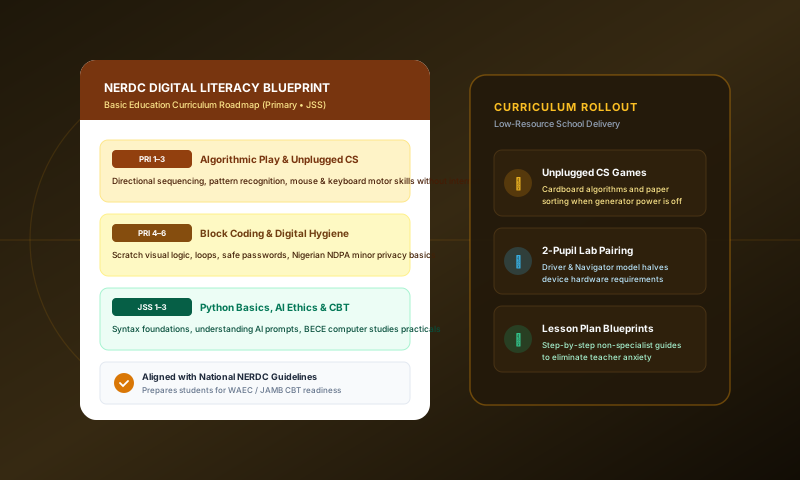
1. Primary 1 to 3 (Lower Basic): Algorithmic Thinking Without Screens
A widespread misconception among school proprietors is that digital literacy cannot begin without a 1:1 computer lab. The NERDC framework explicitly encourages Unplugged Computer Science for early learners:
- Directional Logic: Games where pupils guide classmates through a grid maze using directional commands ("Move 2 steps forward, turn 90 degrees right"), introducing the core concept of programmatic sequencing.
- Pattern Recognition: Identifying repeating motifs in African textile designs (Adire, Akwete) and musical rhythms, translating cultural heritage into foundational algorithmic pattern matching.
- Basic Hardware Literacy: Identifying touchscreens, cameras, and keyboards as modern data capture sensors.
2. Primary 4 to 6 (Middle Basic): Visual Block Coding & Cyber Safety
In Middle Basic, students transition from conceptual logic to structured digital creation:
- Block-Based Programming: Using platforms like Scratch to assemble visual puzzle blocks that control animations, interactive stories, and simple educational math quizzes.
- Data Protection & Privacy: Early awareness of the Nigeria Data Protection Act (NDPA 2023). Students are taught never to disclose home addresses, parent telephone numbers, or biometric photos to online gaming portals or unfamiliar websites.
- Keyboard Fluency: Systematic touch typing drills replacing single-finger pecking, establishing a target typing speed of 20 to 25 words per minute before completing primary education.
3. Junior Secondary (JSS 1 to 3): Syntax, Web Foundations & AI Ethics
By the time students enter JSS 1, they are prepared for formal computational foundations:
- Introductory Python & HTML/CSS: Moving beyond drag-and-drop blocks to write simple text-based loops, conditional statements (
if/else), and styling personal portfolio web pages. - AI Ethics & Content Verification: Training students to distinguish between human-researched facts and AI-generated text, understanding how Large Language Models generate hallucinations, and recognizing why submitting AI-generated essays without critical evaluation is intellectual dishonesty.
- CBT Readiness: Timed multiple-choice assessments testing both theoretical concepts and practical problem-solving on standardized examination simulators.
Overcoming Computer Teacher Shortages
The greatest barrier to curriculum delivery in Nigerian schools is not software—it is teacher confidence. Most computer teachers have never received structured training in block coding or computational pedagogy. Harmony Digital Consults conducts termly Teacher Upskilling Bootcamps that equip non-specialist educators with modular, step-by-step lesson plans aligned with the NERDC scheme of work. Explore our educator development programs or request curriculum consultation for your school.
Share this article
Interested in learning more? Get in touch with us.