
JAMB Subject Combinations: 9 Mistakes That Cost Students Their Dream Course Every Year
The Score Was Excellent. The Admission Never Came.
Picture a candidate who scores above 300 in the UTME, celebrates with family, and then watches admission season pass without a single offer. It happens more often than most families realise. JAMB data reported over five admission cycles showed that no fewer than 5,000 candidates who scored 300 and above still failed to secure admission into any university, polytechnic, or college of education. Among the chief reasons JAMB itself listed: wrong O'Level subject combinations, alongside low screening scores and missed screenings.
The painful part is that many of these losses are avoidable. A wrong UTME subject combination can disqualify a candidate from a course regardless of how high the score is, and in most cases the institution never sends a warning. The admission simply does not progress. This article walks through the nine mistakes behind that silence, and how to avoid each one.
How JAMB Subject Combinations Actually Work
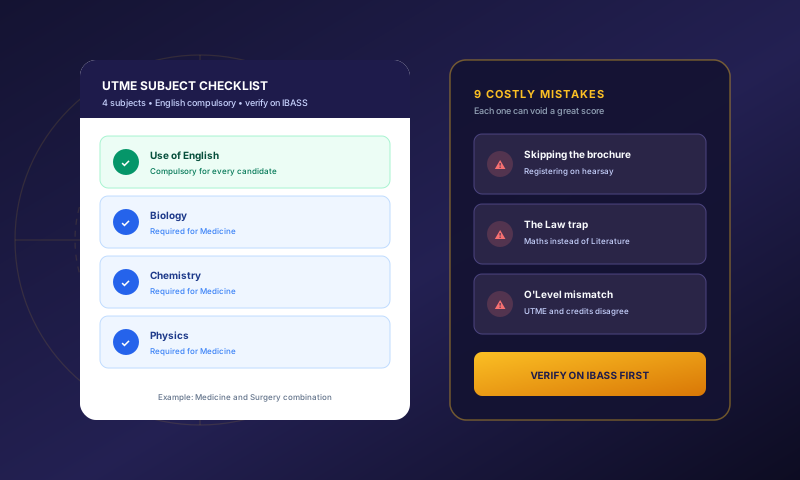
Every UTME candidate sits for four subjects: Use of English, which is compulsory for everyone, plus three other subjects related to the intended course of study. Choosing the wrong combination can disqualify your admission even with a strong score.
Two documents govern everything. The first is the JAMB brochure, available through the official IBASS portal at ibass.jamb.gov.ng, which lists the correct subject combination for every course at every institution. The second is your O'Level result: a minimum of five credit passes including English Language, with Mathematics compulsory for science, social science, and technology courses, acceptable in a maximum of two sittings across WAEC, NECO, or NABTEB. Your UTME subjects and your O'Level credits must tell the same story.
The 9 Mistakes
1. Never opening the JAMB brochure
The single most common failure point is registering based on hearsay: what a friend wrote, what a senior advised, what "everyone knows." The brochure exists precisely because requirements differ by course and by institution. Before you choose anything, look up your exact course and your exact first-choice institution on ibass.jamb.gov.ng. It takes minutes and prevents months of regret.
2. Choosing subjects for ease instead of for the course
Candidates sometimes pick subjects they find easy rather than subjects their course requires, for example choosing Literature instead of Biology for a science-related course, or combining unrelated subjects for a professional course. The UTME is not testing your comfort zone. It is testing your readiness for a specific degree. Match subjects to the course first, then prepare hard.
3. The Law trap: Mathematics instead of Literature in English
Law is one of the most competitive courses in Nigeria, and its combination is strict: Use of English, Literature in English, Government or History, and one other Arts or Social Science subject. Candidates who substitute Mathematics for Literature, often because they are science-leaning students chasing prestige, render themselves ineligible no matter their score. If Law is the dream, Literature is non-negotiable.
4. The Medicine trap: swapping out a core science
Medicine and Surgery requires Use of English, Biology, Chemistry, and Physics across institutions. A University of Abuja dean once illustrated the point publicly: a Medicine aspirant who registers English, Chemistry, Literature, and Geography has the wrong combination and will not be admitted into any Faculty of Medicine, even with the highest score in the hall. Every science subject in the combination is load-bearing.
5. Forgetting that O'Level must agree with UTME
Some candidates fix their four UTME subjects but neglect the other half of the requirement. You need five O'Level credits including English Language, and Mathematics is compulsory for science, social science, and technology courses. A candidate who aces the UTME but lacks the required O'Level credits, or whose O'Level subjects contradict the chosen course, will still be screened out. Check both sides of the equation together.
6. Assuming every university wants the same combination
Requirements are not uniform across institutions. The brochure lists combinations per course per institution for a reason: one university's Engineering may emphasise a subject another treats as optional. Do not copy a friend's combination for a different school. Verify your own institution's entry.
7. Choosing a course your university does not offer
Not every university offers every course. Candidates occasionally select a first-choice institution without confirming the course exists there, then discover after registration that the programme was never available. The brochure confirms course availability too. Check it before you commit your first and second choices.
8. Registering subjects you never studied in secondary school
Some candidates register UTME subjects they never properly studied, hoping to learn them before the exam. Nothing in the rules forbids it, but it usually ends in poor performance. Register subjects you have genuinely studied and can demonstrate competence in. Your preparation time is finite; spend it deepening real knowledge, not starting from zero.
9. Rushing the final review at the CBT centre
Registration-day pressure causes the last and most frustrating errors: a wrong subject left uncorrected, a misspelt name, a mismatched date of birth. Before the operator submits, review every line on the screen: your four subjects against the brochure entry, your personal details, your institution and course choices. The few minutes this takes are the cheapest insurance in the whole admission journey.
The 10-Minute Verification Checklist
Run this before your registration is submitted:
- My four subjects are Use of English plus the three my course requires.
- I confirmed the combination on ibass.jamb.gov.ng for my exact course and institution.
- My O'Level has five credits including English, plus Mathematics if my course area requires it, within two sittings.
- My chosen institution actually offers my course.
- Every subject I registered is one I studied in secondary school.
- I reviewed all personal details and choices on the registration screen.
What If You Already Registered Wrong?
If the error is discovered before the exam, the priority is correction, not panic. JAMB provides windows for correcting registration details and for changing course or institution, for a fee. Check the current JAMB bulletin for what is open and the deadline. If the exam is already written, one practical route candidates use is applying for a change of course to a programme that matches the subjects actually registered. Either way, act on the official JAMB channels, not on roadside advice.
Check Before You Choose
Subject combinations are a small decision with an outsized consequence, and they reward the candidate who verifies instead of assumes. PathVerge, Harmony's career guidance platform, helps students and counsellors explore courses alongside their JAMB subject and O'Level requirements before choices are locked in. Whatever tool you use, let the official JAMB brochure have the final word. Your dream course deserves ten careful minutes.
Share this article
Interested in learning more? Get in touch with us.