How to Choose a School Management System in Nigeria: A Buyer's Checklist
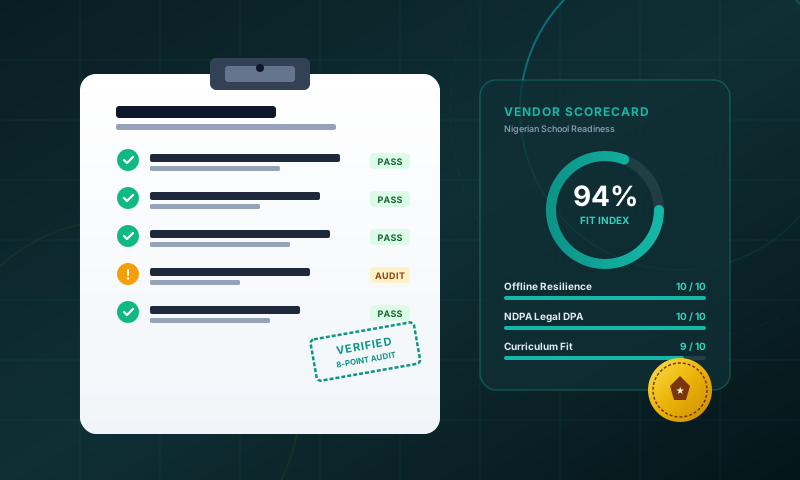
Why This Checklist Exists
Every term, Nigerian school owners and administrators sit through software demos that look impressive in the conference room and fall apart in the staff room. The vendor's slide deck is polished. The interface is clean. The references are glowing. Six months later, half the teachers have stopped using the system and the school is paying for a tool nobody opens.
This happens because most schools evaluate the wrong things. They look at features instead of fit. They compare price tags instead of total cost of ownership. They take vendor claims at face value instead of testing them. This checklist is designed to stop that cycle.
Use it before you sign anything. Print it out. Bring it to demos. Make the vendor answer every question in writing.
Section 1: Connectivity and Resilience
This is where most systems silently fail. If you remember nothing else, remember this section.
- Does the system work when the internet is down? Not "some features" — does the core workflow (attendance, grading, fee tracking, communications) work offline?
- Can a teacher mark attendance for an entire day's lessons in airplane mode, then sync when connectivity returns?
- What happens to data entered offline if the device is lost before it syncs? Is there a local backup?
- How does the system handle two teachers editing the same record offline?
- What is the typical daily data consumption per device in megabytes? (If the vendor cannot answer this, they have not measured.)
- Does the system work on 2G or weak 3G signals?
Section 2: NDPR and Data Protection Compliance
Under the Nigeria Data Protection Act (NDPA) 2023, your school is a data controller. The vendor is a data processor. The legal liability for misuse, breach, or unlawful processing of student data largely sits with you. Get this section right.
- Where is student data stored geographically? Servers in Nigeria, Europe, or the United States have very different legal implications.
- Does the vendor have a Data Processing Agreement (DPA) you can sign? Is it NDPA-compliant?
- Is the vendor registered as a Data Processor with the Nigeria Data Protection Commission (NDPC)?
- Is data encrypted at rest and in transit? What encryption standards?
- Who at the vendor has access to your data? Is there an audit log?
- What happens to your data if you cancel the contract? Is it deleted, and how do you verify deletion?
- Does the system support role-based access control, so a class teacher cannot see another class's records?
- Does the system log every access to a student record? (Required for breach investigation.)
- How does the vendor handle a data breach? Will they notify you within the 72-hour window the NDPA requires?
- Are consent management features built in (parental consent for under-18s, withdrawal of consent, etc.)?
Section 3: Curriculum and Local Fit
- Does the system support Nigerian terminology (terms, sessions, JSS, SSS) or does it use international terms like "semesters" and "grades"?
- Are grading scales aligned with WAEC, NECO, and Nigerian school report card conventions?
- Does the system support the NERDC scheme of work for lesson planning?
- Can it produce UBE/SUBEB-compliant reports for government submission?
- Can fee structures handle Nigerian realities (Naira, term-based billing, instalments, multiple ward discounts)?
- Are SMS and WhatsApp gateway integrations available for parent communications? (Many Nigerian parents do not check email.)
Section 4: Total Cost of Ownership
The sticker price is rarely the real cost. Ask for the all-in number.
- What is the per-student or per-school annual cost?
- Are there setup fees, training fees, or migration fees?
- Does the price include software updates and security patches?
- Is support included or is it a separate package? What are the support hours? Is support available in English with Nigerian context, or routed to an offshore team unfamiliar with local exam systems?
- What happens to the price after year one? Many vendors offer aggressive year-one discounts and then double the price.
- Is there a per-feature pricing model where core features cost extra? (Bad sign.)
- If the school grows from 200 to 500 students, what does the cost become?
- What is the cost to export your data if you leave? (Some vendors charge per-record export fees that effectively trap you.)
Section 5: Implementation and Training
- How long does implementation take, realistically? Two weeks? Two terms?
- Who migrates existing student records and historical data? Is that included in the price?
- How many hours of training are included for administrators, teachers, and accounts staff?
- Is training delivered on-site, virtually, or via recorded modules? Mixed delivery is best.
- Is there ongoing training for new staff hires throughout the year?
- Is there a Nigerian implementation partner or is the team based abroad?
Section 6: Reliability and Support
- What is the vendor's uptime guarantee? (Anything less than 99 percent is not serious.)
- How are critical issues escalated? Is there a phone number you can call, or only an email ticket queue?
- What is the average response time for a critical issue?
- How long has the vendor been operating in Nigeria specifically?
- Can the vendor provide references from at least three Nigerian schools of similar size? Call them.
- What happens if the vendor goes out of business? Can you export your data into a standard format (CSV, Excel) and migrate to another system?
Section 7: Features That Actually Matter (and Ones That Do Not)
Do not be dazzled by feature checklists. The features that matter are the ones your staff will use weekly. Ask:
- How long does it take a teacher to mark attendance for one class? (More than 30 seconds is too long.)
- How many clicks does it take to record a fee payment?
- How long does it take to generate an end-of-term report for one student?
- Can teachers enter grades on a phone, or do they need a laptop?
- Can parents check their child's attendance and grades on a phone without installing an app?
Features that sound impressive but rarely deliver value at school scale: built-in video conferencing (use Zoom or Google Meet), AI-powered analytics that nobody reads, complex CRM functionality, gamified student leaderboards.
Section 8: Vendor Trust Signals
- Is the vendor a registered Nigerian company? Ask for the RC number.
- Where is the head office and the support team physically located?
- Does the vendor have a published security policy and incident response plan?
- Is the vendor pursuing or holding ISO 27001 certification?
- Does the vendor publish a status page showing historical uptime?
- Has the vendor disclosed any past data breaches, and how did they respond?
The Three-Demo Rule
Do not buy after one demo. Ever. Schedule three:
- First demo — let the vendor show you their best pitch.
- Second demo — bring three teachers from your school and have them walk through their actual daily tasks. Watch where they hesitate.
- Third demo — ask the vendor to demonstrate a specific scenario from your school. Marking attendance offline, generating a SUBEB report, handling a fee instalment with a partial waiver. If they cannot, that is the answer.
The Two Questions That Reveal Everything
If you only have time to ask two questions, ask these:
- "Can you show me, right now, what happens when I turn off the Wi-Fi on this laptop?"
- "Can you send me a copy of your NDPR-compliant Data Processing Agreement?"
How vendors respond to these two questions tells you most of what you need to know.
A Word on Where Harmony Digital Fits
EduTrack Nigeria, our school management system, was built against this checklist. Offline-first, NDPR-compliant by design, aligned to WAEC and NERDC curricula, with a Nigerian implementation team and a clear data processing agreement that any school can sign. We do not pretend to be the only option, but we built it because we could not find an alternative that ticked every box. Request a demo and we will run it through this checklist together, in front of you, with the Wi-Fi off.
Share this article
Interested in learning more? Get in touch with us.