
AI Lesson Planning Without the Hallucinations: A Verification Workflow for Nigerian Teachers
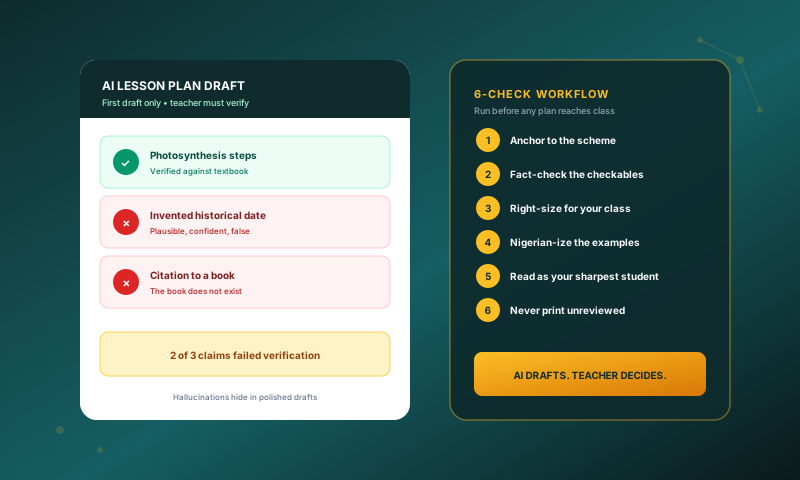
The Lesson Note That Taught Something False
Imagine a teacher who asks an AI tool to draft a lesson note on a history topic, prints it, and teaches it with confidence. Midway through the lesson, a bright student raises a hand: "Sir, that date is not correct." The teacher checks the textbook that evening and discovers the AI had invented a plausible-sounding date, complete with a confident explanation. The lesson was well structured, beautifully formatted, and wrong.
This is not a rare glitch. It is the central risk of using generative AI for lesson planning, and it has a name: hallucination. The good news is that it is entirely manageable, provided the teacher treats the AI as a drafting assistant and never as an authority. This article gives you a practical workflow for doing exactly that.
Why the Confident Tone Fools Us
AI language models work by predicting the most likely next word based on patterns learned from massive text datasets. They do not truly understand meaning, and they have no way to verify what they write. When you ask for a lesson plan on photosynthesis, the model assembles something that looks like a lesson plan because it has seen many similar structures, and it sounds authoritative because it has learned what authoritative educational writing sounds like.
But the model cannot check a biology textbook. It cannot open your scheme of work. So when it needs a date, a definition, a formula, or a citation, it generates text that fits the pattern, which is sometimes a fabrication delivered with total confidence. Fake citations, books that do not exist, wrong dates and formulas, and invented quotations are the classic forms. This matters more in education than in most fields, because the audience, your students, often cannot spot the errors.
The essential shift is this: your role moves from consumer to critical editor. The AI provides a first draft; you provide the expertise. That relationship works well when you can quickly spot errors, and it works poorly for unfamiliar content where you cannot verify accuracy. The workflow below is built around that reality.
The 6-Check Verification Workflow
Run every AI-assisted lesson plan through these six checks before it reaches your classroom. Together they take about ten minutes once they become habit.
1. Anchor to the scheme first
Before you even read the AI's draft closely, confirm the topic, scope, and sequence against your school's scheme of work and the NERDC curriculum. AI tools do not know your scheme. They may teach a topic at the wrong depth, in the wrong order, or with objectives that do not match what your students will be examined on. If the draft drifts from the scheme, correct the drift first; everything else is secondary.
2. Fact-check the checkables
Go through the draft and circle every verifiable claim: dates, names, formulas, definitions, statistics, quotations, and references. Check each one against a trusted textbook or source you already use. Pay special attention to citations and book titles, which AI tools are notorious for inventing wholesale. A reference list that looks scholarly is the single most common hallucination in educational content. If you cannot verify a claim quickly, cut it or replace it with one you can defend.
3. Right-size for your class
AI drafts tend to assume an ideal classroom: moderate size, ample time, and students at exactly the stated level. Compare the plan against your reality. Will the activities fit into your actual periods? Is the language right for your students' level? Does it account for a class of sixty, or a double period that sometimes becomes a single? Adjust timings, simplify or deepen explanations, and split activities that assume resources you do not have.
4. Nigerian-ize the examples
AI models are trained largely on content from outside Nigeria, so their examples, case studies, and illustrations often feel foreign to your students. Replace them deliberately with local ones: Nigerian industries, local geography, familiar names, and situations your students recognise from daily life. This is not cosmetic. Students learn faster when new concepts attach to what they already know, and a lesson that feels imported is a lesson half lost.
5. Read it as your sharpest student
Read the final draft skeptically, the way your most curious student would. Ask of each section: is that actually true? Does this step follow from the last one? Could a student misunderstand this explanation? This adversarial read catches the subtle errors that survive fact-checking: the misleading analogy, the step skipped in a derivation, the definition that is technically right but confusing at this level. If something makes you pause, it will stop a student cold.
6. Never print unreviewed
This is the rule that makes the other five stick: no AI-assisted plan goes to the classroom, the photocopier, or the students' notebooks without passing through your judgment. The moment a draft skips review "just this once" is the moment a hallucination reaches thirty students who will carry it into their exams. Keep the human in the loop every single time, and the technology stays a servant rather than a substitute.
The 10-Minute Pre-Print Checklist
Tape this to your desk until it becomes reflex:
- The topic, scope, and objectives match my scheme of work and the NERDC curriculum.
- Every date, name, formula, definition, and quotation is verified against a trusted source.
- All citations and book titles are real; anything unverifiable is removed.
- Timings, language level, and activities fit my actual class size and periods.
- Examples and illustrations are localised for my students.
- I have read the plan skeptically, as my sharpest student would.
What AI Is Genuinely Good At Here
This workflow is not anti-AI. Used with verification, these tools are genuinely useful: brainstorming varied classroom activities so you are not repeating last term's approach, generating differentiated exercises for fast and struggling learners, drafting assessment questions at different cognitive levels, and re-explaining a difficult concept in simpler language for a student who missed the point. The pattern is consistent: AI is excellent at generating options and terrible at guaranteeing truth. Let it do the first, and keep the second firmly in your hands.
The Bigger Picture
The education world is converging on this same conclusion. UNESCO published its first global Guidance on Generative AI in Education and Research in September 2023, followed by AI competency frameworks for teachers and students in 2024. The consistent message across that guidance is a human-centred approach: institutions should validate AI systems before classroom use, teachers need training to navigate these tools, and the technology must serve learning rather than replace the educator's judgment. Your six-check workflow is that principle applied on Monday morning.
Learn to Use AI Well, Not Just Fast
Verification is a skill, and like any teaching skill it improves with deliberate practice. Harmony's AI-in-Education Professional Certificate trains educators in the practical, responsible use of AI tools for teaching, from prompt design to exactly this kind of output verification. Whether you train with us or on your own, make this your standard: AI drafts, the teacher decides, and no hallucination ever reaches the classroom.
Share this article
Interested in learning more? Get in touch with us.